
At many airports, lighting is treated as infrastructure. Necessary. Functional. Invisible.
For the new lighting concept of the Aeroporto dello Stretto “Tito Minniti” in Reggio Calabria, the ambition was very different. The lighting design team of Cannata Light approached the airport as a gateway to the Mediterranean: a place shaped by movement, reflections, atmosphere and identity.
The result is not simply a lighting installation. It is a dynamic digital layer woven into the architecture itself.
Inspired by the Strait of Messina, the colours of the sea and the constantly changing Mediterranean sky, the project transforms the passenger experience into something more fluid, immersive and emotional.
One of the strongest ideas throughout the original design vision was the concept of flow.
The lighting had to evoke:

Rather than creating static illuminated areas, the designers imagined continuous lines of light moving through the terminal architecture.
This philosophy became especially visible in:
The airport itself became the storytelling medium.

At the heart of the project is a next-generation real-time generative content and management control system that transforms the airport into an experiential architectural environment.
The hybrid control platform built around POET Creator software allows the airport lighting and media environment to behave as one unified architectural system rather than separate technical layers. Instead of simply replaying fixed content, the system enables real-time generative visuals, dynamic RGBW lighting transitions and responsive environmental scenes to operate together across the terminal.
This creates a more fluid and immersive passenger experience while allowing the airport atmosphere to continuously evolve throughout the day. The platform also provides long-term flexibility for future seasonal content, event scenarios and adaptive environmental storytelling without changing the physical installation itself.
To bring that vision to life, the project integrates a large-scale combination of dynamic RGBW lighting systems and transparent media architecture.
In total, the installation contains:
To put that into perspective: If every light point were placed in a single line, they would stretch almost 4 kilometres.
Those numbers are impressive technically. But more importantly, they support the architectural intent behind the project: making light feel alive.

A large part of the installation uses the Vivalyte VNL-S20 flexible RGBW pixel system.
Across the airport, more than:
were integrated into flowing architectural light lines.
These dynamic lines guide passengers intuitively through the space while continuously changing atmosphere and perception.
Instead of treating lighting as separate objects added afterwards, the lines become part of the spatial language of the airport itself.
The designers specifically wanted the lighting to feel fluid and non-invasive. A system capable of subtle transitions, movement and evolving colour scenes was therefore essential.
One of the most striking interventions is the suspended Phantom Mesh installation above the escalator zone.
The installation uses:
The goal was not to place a conventional screen inside the terminal, but to create a digital layer that remains visually lightweight and architecturally integrated.
The transparent mesh allows content, movement, and atmosphere to appear suspended in space while preserving openness and sightlines.
This perfectly matched the project’s broader vision of creating “a poetry written with light,” as described in the original concept document.

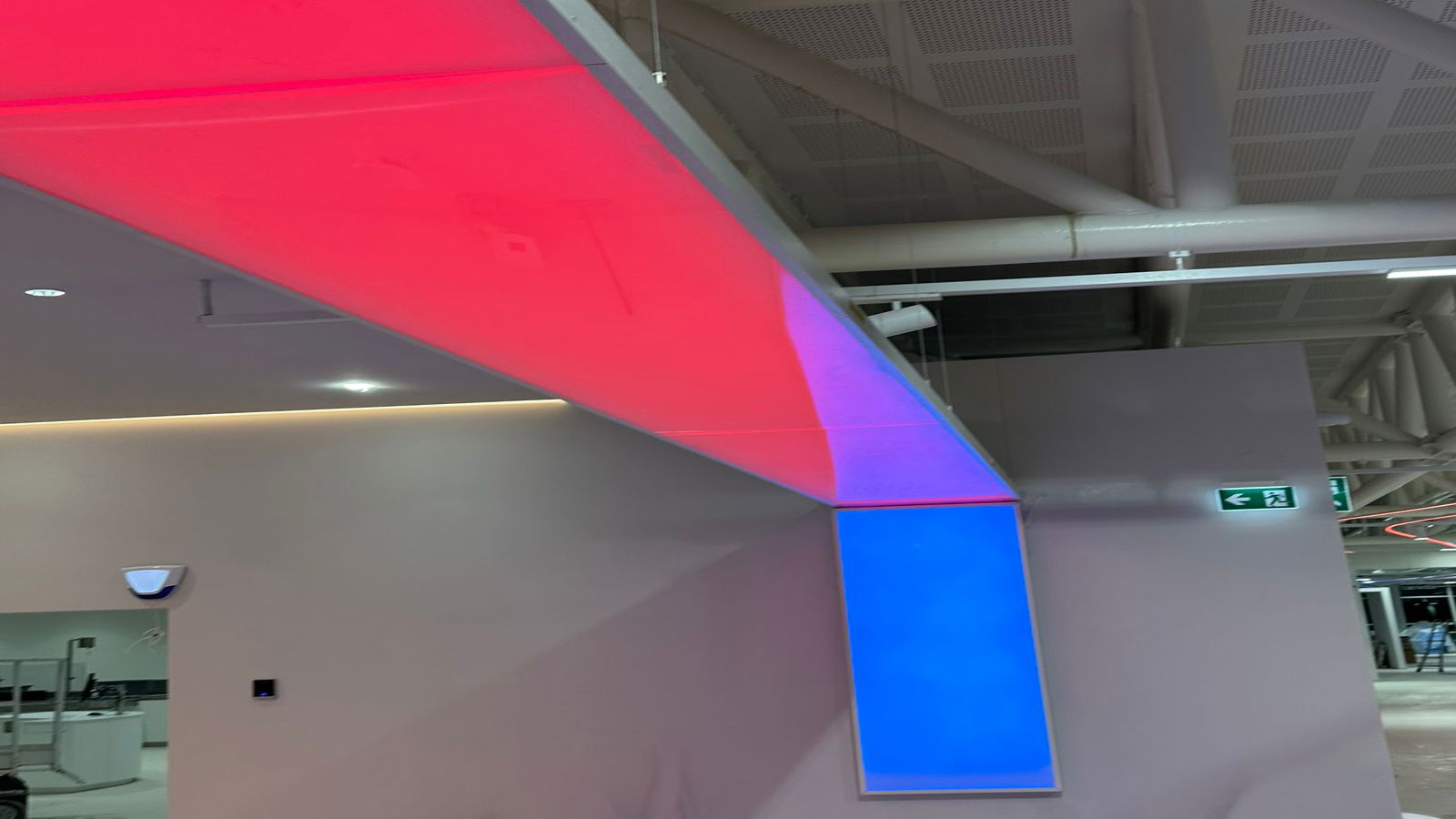
The illuminated portal at the escalator entrance was designed as a moment of transition.
Using:
The installation creates a welcoming digital threshold between different areas of the airport.
The lighting gently guides movement while creating a more emotional passenger experience. Rather than overwhelming travellers, the system was designed to feel soft, fluid, and intuitive.
Throughout the concept phase, references to the Mediterranean landscape played a central role:

This is why RGBW technology became such an important part of the project.
Dynamic colour transitions allow the airport to evolve throughout the day:
The lighting system behaves less like static infrastructure and more like a living environmental layer.
While the project is highly expressive visually, technical sustainability and reliability were equally important in the specification process.
The design document strongly emphasised:
For the exterior canopy lighting, marine-grade powder coating and asymmetric louvers were used to handle the demanding Mediterranean coastal environment while carefully managing light pollution.
The result is a system that combines:
What makes this project particularly interesting is that it never treats lighting as decoration alone.
The lighting becomes:
Or, as the project team described it:
“The airport no longer only transports people. It transports atmosphere.”
